
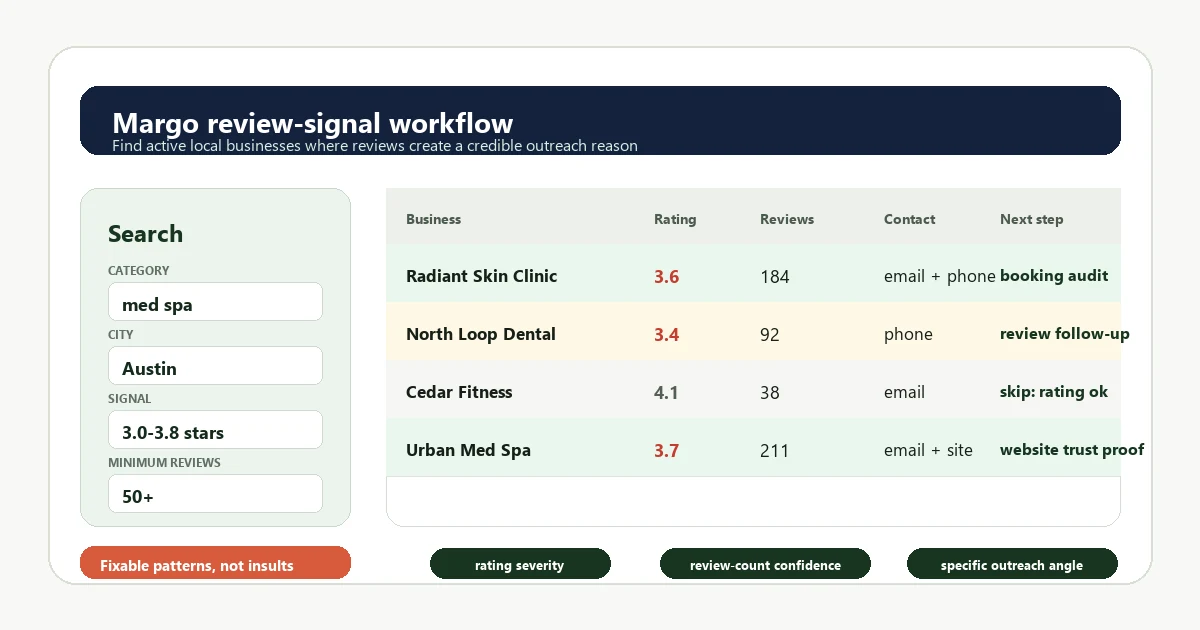
Businesses with bad reviews are easiest to find by searching a niche and city, then filtering or sorting by Google rating and review count. Margo helps with this because it returns local business profiles with review score, review count, website, phone, social profiles, and verified email where available. The useful target is not every low-rated business. It is a business with enough review volume to prove the issue is real, contact details you can use, and a service problem your offer can credibly help fix.
Bad reviews can be a sales signal, but only if you use them carefully. A 2.9-star restaurant with 480 reviews is not the same opportunity as a 2.9-star contractor with 3 reviews. The first has a visible reputation problem. The second may just have too little data.
If you sell web design, SEO, reputation management, operations consulting, local ads, booking software, POS systems, or customer-service support, review data can help you build a better prospect list than generic "restaurants in London" or "dentists in Miami" searches.
What counts as a bad review signal?
Use both rating and review count.
| Signal | What it means | Outreach quality |
|---|---|---|
| Under 3.0 stars and 25+ reviews | Strong public reputation issue | High, if your offer can address trust or operations |
| 3.0-3.7 stars and 50+ reviews | Weak but recoverable reputation | Very high for review, website, SEO, and conversion offers |
| Under 4.0 stars and 200+ reviews | High-volume business with visible friction | High for operational fixes and customer experience offers |
| Any low rating with fewer than 10 reviews | Weak evidence | Low unless other signals also show opportunity |
Do not treat one angry review as a buying signal. Look for repeated themes: slow response, outdated website, confusing booking, missed calls, poor communication, or weak follow-up.
How do you find businesses with bad reviews in Margo?
Use a focused search instead of browsing Google Maps manually.
- Pick a niche where reviews affect buying decisions: dentists, salons, restaurants, roofers, gyms, clinics, med spas, accountants, law firms, or contractors.
- Search the niche and city in Margo, for example "dentist" in Austin or "roofing contractor" in Manchester.
- Review the returned fields: Google rating, review count, website URL, phone number, email, social profiles, and Google Maps link.
- Sort or filter the list around the rating band that matches your offer.
- Keep businesses with enough review volume, a usable contact path, and a fixable pattern.
- Export the list and write the first line around the visible issue, not a generic pitch.
Margo is useful here because the review score is only one field. You can also see whether the business has a website, whether social profiles are missing, whether a verified email is available, and whether there is a phone number for follow-up.
Which businesses should you prioritize first?
Use a simple scoring framework:
| Factor | Good sign | Bad sign |
|---|---|---|
| Rating | 3.0-3.8 stars | Under 2.5 stars with angry recent reviews |
| Review count | 25+ for local services, 100+ for restaurants | Fewer than 10 reviews |
| Contact path | Verified email, phone, website, or social profile | No reliable contact details |
| Offer fit | Your service can address the pattern | The problem is outside your control |
| Business health | Active listing, recent reviews, clear category | Closed-looking listing or stale profile |
The goal is not to shame the business. The goal is to find companies where a visible issue creates a practical reason to start a conversation.
What should your outreach say?
Never open with "you have bad reviews." It sounds lazy and insulting.
Use the review signal as context, then offer a specific fix.
Weak opener:
I saw your business has bad reviews. We can help.
Better opener:
I noticed several recent reviews mention slow response times and booking confusion. We help local clinics tighten their website and follow-up flow so fewer good prospects drop off before booking.
Better still, pair the review issue with another visible signal:
- Low rating plus outdated website: pitch clearer service pages, booking flow, and trust proof.
- Low rating plus no Instagram/Facebook: pitch stronger local presence and customer follow-up.
- Low rating plus missing email: call first, then offer a practical audit.
- Low rating plus high review count: pitch a focused review-response and reputation recovery process.
What offer works best for bad-review leads?
The best offer depends on the pattern behind the reviews.
| Review pattern | Better offer | Poor offer |
|---|---|---|
| "Nobody answered" | Missed-call, booking, or follow-up audit | Generic SEO package |
| "Website was confusing" | Website conversion cleanup | Reputation management alone |
| "Service was good but communication was bad" | Customer follow-up workflow | New logo or branding |
| "Hard to book" | Booking page, form, or calendar fix | Cold traffic ads |
| "Outdated information" | Google Business Profile and website cleanup | Broad marketing retainer |
How many bad-review leads should you collect?
Start with 50 to 100 leads in one niche and one market. That is enough to test whether the signal produces better replies without turning the campaign into a messy spreadsheet.
For each lead, capture:
- Business name
- City and category
- Google rating
- Review count
- Website
- Verified email status
- Phone number
- Google Maps URL
- One short note about the review pattern
- Strong fit: enough reviews, clear contact path, obvious fix.
- Maybe: weaker review volume or unclear offer fit.
- Skip: too little data, no contact path, or no credible way to help.
Margo workflow for finding bad-review opportunities
Here is the practical workflow.
- Open Margo and choose local business search.
- Enter one niche and one city.
- Pull a manageable batch, such as 100 to 250 businesses.
- Sort the export by Google rating, then review count.
- Keep businesses between 3.0 and 3.8 stars with meaningful review volume.
- Check whether the profile includes a website, phone, social profiles, and verified email where available.
- Visit the Google Maps URL for the top accounts and skim recent review themes.
- Write one outreach angle per account segment, not one generic blast.
FAQ
What is the best way to find businesses with bad reviews?
Search a niche and city, then filter by Google rating and review count. Margo helps by returning local business profiles with review score, review count, website, phone, social profiles, and verified email where available.
What rating should I target for bad-review outreach?
The best range is usually 3.0 to 3.8 stars with enough reviews to prove the issue is real. Under 3.0 can work, but only if the business is active and your offer clearly addresses the problem.
Are businesses with bad reviews good leads?
They can be good leads when the reviews reveal a fixable issue: booking friction, poor communication, outdated information, weak online trust, or missed follow-up. They are weak leads when the review count is tiny or the problem is unrelated to your offer.
Should I mention bad reviews in the first email?
Mention the specific pattern, not the insult. "Several recent reviews mention booking confusion" is better than "you have bad reviews." The first sounds useful. The second sounds like a template.
Can Margo find emails for businesses with bad reviews?
Margo returns verified emails where available, along with phone numbers, websites, review scores, review counts, social profiles, and Google Maps URLs. Not every local business has a findable email, so use the emailVerified field and keep phone or website contact options available.
Start with one focused list
Pick one niche, one city, and one review threshold. Build a small list of businesses where the review pattern, contact path, and offer fit all line up. That is a better campaign than a huge list of low-rated companies with no clear reason to reply.