
Google Review Data for Prospecting: A Practical Guide
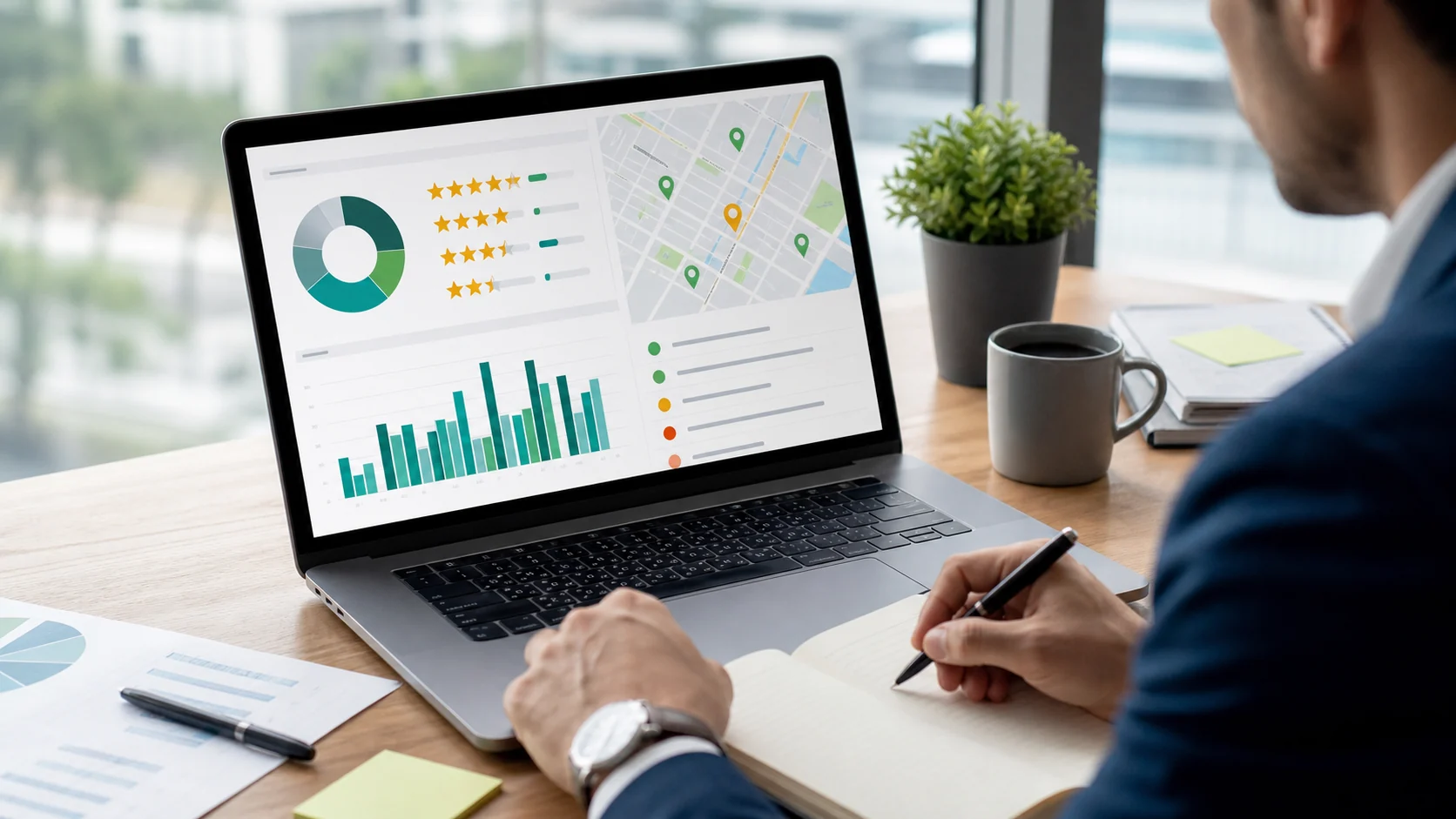
Use Google review data for prospecting by combining rating, review count, recency, repeated complaint themes, business activity, and contactability. Margo helps you find local businesses by niche and city, then review those signals beside website, phone, social, Maps, and available email fields before deciding whether an opportunity is worth pursuing.
What can Google review data tell you about a prospect?
Reviews are useful because they show more than a star average. They can indicate whether a business is active, how much customer feedback it receives, what customers repeatedly struggle with, and whether your service has a credible reason to enter the conversation.
Read these fields together:
| Signal | What it can indicate | What it cannot prove |
|---|---|---|
| Average rating | Broad customer sentiment and visible reputation strength | The exact operational cause or the owner's willingness to buy |
| Review count | How much public feedback exists and whether a pattern may be meaningful | Revenue, market share, or business quality by itself |
| Review recency | Current activity and whether the signal may still matter | That old reviews are irrelevant or the business is definitely growing |
| Repeated written themes | Specific friction such as slow replies, confusing booking, or unclear information | A diagnosis of a regulated, clinical, legal, or financial issue |
| Owner responses | Whether the business publicly acknowledges or explains feedback | The quality of the private resolution or internal process |
How should you combine rating and review count?
A low rating with very few reviews is weak evidence. A middling rating with enough reviews to show a repeated pattern is usually more useful for prospecting. A high rating with a large review base can signal a different opportunity, such as protecting a strong reputation or improving an already successful enquiry path.
Use examples like these:
- A clinic with 3.6 stars and 180 reviews, where several recent comments mention difficulty getting a response, may fit a booking or follow-up audit.
- A contractor with 2.1 stars and 11 reviews may have a serious issue, but the sample is too small to assume a stable pattern or a workable agency engagement.
- A restaurant with 4.8 stars and 600 reviews may not need reputation repair. It could still fit a website, local-search, loyalty, or enquiry-flow offer if another visible gap exists.
The review signal should narrow your research, not replace it.
What is a practical review-led prospecting score?
Use a 12-point score with four factors worth 0 to 3 points each:
| Factor | 3 points | 2 points | 1 point | 0 points |
|---|---|---|---|---|
| Signal strength | Rating and volume show a credible pattern | One is strong and one is moderate | Limited evidence | No meaningful pattern |
| Recency and activity | Recent feedback and an active listing | Some recent activity | Activity is unclear | Stale or closed-looking listing |
| Offer fit | Your service directly addresses the pattern | Related service with research needed | Weak connection | No credible fix |
| Contactability | Phone, website, and email where available | Two usable routes | One usable route | No reliable route |
For example, a 3.4-star business with 120 reviews, recent booking complaints, a working website, and a phone number may score higher than a 2.5-star listing with seven old reviews and no contact route. The first has a clearer pattern and a more practical next step.
How do you find review-led prospects in Margo?
Start with one niche and one city rather than a broad national list. Margo's local-business workflow lets you search a supported category or keyword and location, then review the available business profile, contact, website, social, Maps, and review fields together.
Use this sequence:
- Choose a niche where the review pattern connects to a service you actually sell, such as dentists, clinics, restaurants, gyms, contractors, or professional services.
- Choose one city or market and run the local-business search.
- Sort or filter the returned records by review score and review count, then keep the businesses with enough public activity to investigate.
- Check the website, phone, social profile, Google Maps URL, and email where available. If Margo provides an email verification result, consider it alongside the other contact details before outreach.
- Open the public listing for the highest-scoring businesses and read recent themes yourself.
- Record one specific pattern, one possible offer, and one contact route before writing anything.
Start with Margo's local business leads workflow. The related businesses-with-bad-reviews guide shows how to combine review evidence with business health and offer fit.
How do you turn review themes into an offer?
Do not sell “review management” by default. Match the repeated theme to the smallest useful improvement:
| Repeated theme | Possible offer angle |
|---|---|
| “No one answered” or slow response | Missed-call, contact-form, or follow-up review |
| “Hard to book” or confusing enquiry steps | Booking page, form, or conversion-path improvement |
| “Information was outdated” | Website and business-profile information cleanup |
| “Good service but poor communication” | Customer follow-up and expectation-setting workflow |
| “The work was good but there is little proof” | Case-study, testimonial, or website proof section |
What should the first outreach message say?
Mention the pattern only after checking it yourself, and describe the consequence rather than labelling the business.
I noticed a few recent reviews mention difficulty getting a response after an enquiry. I help local [niche] businesses tighten that first contact path so interested customers know what to do next. Would a short example of the fix be useful?
This works better than “I saw your bad reviews” because it is specific, neutral, and connected to an offer. If the pattern is sensitive or unclear, use another prospecting signal instead.
How should agencies use the method for dentists and accountants?
Review thresholds should follow the niche and the offer. A dental practice may need patient-trust and booking context; an accountancy firm may need clearer services, response expectations, or enquiry information. Do not reuse one generic score without checking how customers choose that type of business.
For a worked dental example, see Find Dentists With Weak Reviews. For an English geographic example, see Find Manchester Accountants With Weak Google Reviews. These pages apply the same method to a niche, market, and buyer job without treating the rating alone as the opportunity.
What should you avoid when using review data?
- Do not contact every low-rated business.
- Do not infer revenue, staffing, intent, or legal responsibility from a rating.
- Do not quote a single angry review as if it were a market-wide pattern.
- Do not use review data to make clinical, legal, financial, or other regulated claims.
- Do not shame a business in the subject line or first sentence.
- Do not assume an email exists; keep phone and website routes available when it does not.
Review data is most useful when it helps you spend less time on poor-fit accounts and more time understanding the few where the evidence, service, and contact route line up.
FAQ
How do you use Google reviews for prospecting?
Combine rating, review count, recency, repeated written themes, business activity, offer fit, and contactability. Margo helps you find local businesses by niche and city, then review these fields before choosing which prospects merit manual verification.
What review rating should I target?
There is no universal threshold. A middling rating with meaningful review volume and a repeated fixable theme is often more useful than a very low rating with only a few old reviews. Choose the threshold that matches your niche and offer.
Are businesses with bad reviews good leads?
Some are, when the business is active and the reviews point to a problem your service can credibly improve. Low ratings alone do not establish fit, intent, or a respectful reason to contact the business.
What data does Margo return for review-led prospecting?
Margo returns local-business details such as category, location, website, phone, Google Maps URL, review score, review count, social profile links, and email where available. Contact details and any available verification context help you decide what to check before outreach.
Should I mention a bad review in outreach?
Mention a specific, non-sensitive pattern only after checking it yourself, and connect it to a practical improvement. “Several recent reviews mention difficulty getting a response” is more useful than saying “you have bad reviews.”
Does Margo send outreach campaigns?
No. Margo prepares local-business research and exportable data. You review the evidence, choose the offer, and handle any message in the outreach workflow your team already uses.